For the many parents of young children in our practice:
For the most part these days, children see pediatric dentists, and this is an excellent development in my view. Modern pediatric dentists not only treat and prevent cavities. They have an understanding of facial growth and development that leads to far more satisfying and healthy outcomes than the old concept of letting the teeth crowd and then aligning them late in the child’s development.
I–Dr. Wilson–am researching and writing a book about how, over a hundred years ago, a cadre of Philadelphia dentists and educators elevated dentistry from a poorly regarded trade to a respected, science-based profession. Yes, while there were others who made major contributions, it was primarily here in our city where the greatest sustained efforts were made.
Esther Schupack, D.D.S. was in the first class at Penn Dental to graduate female dentists, in 1917. Her father, Charles Schupack, D.D.S., and younger brother Isadore, all practiced together in Center City Philadelphia.
What is relevant to Fairmount parents is that, in researching Dr. Esther Schupack’s professional life, I found a superb article on children’s oral health that she wrote for the Hygeia journal in May, 1930. Hygeia was a public health educational publication of the American Medical Association. This paper is extraordinary in that it still holds up perfectly well, 96 years later! I am delighted to present it to you here.
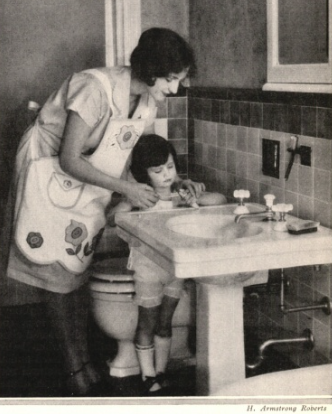
What Every Mother Should Know About a Child’s Teeth
By Esther Schupack, D.D.S.
Hygeia, May 1930, [p. 429-431]
Women who would not neglect their own teeth often ignore the needs of their children’s teeth. Nature discards the baby teeth anyway, they argue, so why bother about them? The naive idea that diseased teeth in younger children require no treatment does immense harm to children’s health.
Pus pockets surrounding the teeth in a child’s mouth set up foci of infection just as they do in adults. There is growing concern about the prevalence of heart disease in children. Child specialists now believe that the so‑called growing pains—aches of the joints—result from infections. Bacteria from diseased teeth pass by way of the blood to lodge in the vital organs and joints and thus undermine the whole system.
Another calamity is the irresponsible way in which uninformed parents, after neglecting the child’s mouth, complacently view extraction of the diseased teeth. It is not generally appreciated that the baby teeth stand guard over the positions to be taken by the permanent teeth and guide the second set into place.
The teeth behind a vacant space in the arch tilt forward as if the jaw were contracting. When the newcomers erupt from the jaw bone their rightful position has disappeared. They turn, twist and lean in order to find a place in the mouth. Instead of an unbroken line of pearly whiteness, the lips part upon a disorganized and disfiguring array.
Nature has planned for the first teeth to last until a certain age, because health and digestion require them. A child who has been cheated out of their use loses some measure of this natural aid to perfect growth and development.
Unwise extraction of teeth is not the only cause of malformed jaws. Sometimes a youngster is discovered to have one jaw smaller than the other. The lower juts beyond the upper or recedes behind it. Proper mastication is, of course, impossible and the face lacks the accepted standards of beauty.
These are sometimes cases of mixed inheritance. The small jaw comes from one ancestral line and the large jaw from another. Modern dental technic through a specialty known as orthodontia—the straightening of teeth—makes it possible to reform the jaw. The smaller arch is widened by slowly moving the teeth, one by one, into correct positions.
Faulty alignment of the teeth, either through inheritance or premature extractions, should have the early attention of the dentist. The age at which reconstruction should begin is so varied that no rule can be stated. But by all means a dentist should be consulted before the child reaches the age of 14. Delay until after 21 makes attempts to reshape the ranking of the teeth inadvisable, because of the denser bone tissue and the unyielding nature of the sockets in an adult.
Orthodontic treatment requires the periodic service of the dentist from several months to several years depending on the age of the child and the positions of the teeth. It is futile to begin this work unless the parent and child are willing to give the dentist continuous cooperation and patiently to await results.
The Six Year Molars
A most distressing oversight frequently occurs in the lack of attention given the six‑year molars. Orthodontia may restore twisted teeth to their natural beauty and utility but once a permanent tooth is gone nothing can really replace it. Artificial teeth may look well but they do not have the natural anchorage in the bone nor can they give the service of one’s own.
A child’s mouth is small. It accommodates only twenty teeth, five on each side of the center, in the upper and lower jaws. These teeth are all temporary and make way for permanent successors. Some time after the age of 5 the first permanent molar begins to appear behind each series of five. The parents have outlived their preoccupation with the coming of the child’s teeth as incidents of major importance and the molars erupt unnoticed.
Soon cavities may appear and the mother, dominated by the idea that these are temporary teeth that need no attention, permits caries, or decay, to spread deeply. A visit to the dentist reveals the necessity for removing the molar or the nerve.
Thus the child, early in life, begins to lose teeth that are necessary for digestion and facial beauty through the rest of his existence.
When the teeth are not facing properly, openings are formed between the teeth, which encourage the collection of food debris. This makes it more difficult to keep the mouth clean.
Children usually first make the dentist’s acquaintance when their mouths are sensitive with pain and they are consequently suspicious of everything said and done to them. Mothers should plan to make the child’s introduction to the dentist a painless one. When the first discoloration appears on the baby’s teeth, he should have the sympathetic, gentle attention of the cleaning brushes in the hands of the dentist. The sensation often tickles children and the mechanical scrubbing, followed by a pleasant mouth wash, establishes a friendly relationship between the child and the dentist. A visit every six months cements friendship and confidence.
Should the painful ministrations of the dentist be required, the child is ready to believe that an effort is being made to help and not to add further hurt.
Lying to a child is the way of failure. If one has a child’s confidence, he can be soothed into patient and stoical endurance of temporary suffering. Tell a trusting child that the additional pain is necessary to end all the aching, and the child will be a Trojan.
Parents are careless about discussing their dental aches and pains in the presence of children. Nine out of ten who rebel fiercely at a necessary visit to the dentist for treatment are in a state of fear because of scraps of conversation overheard in the family circle.
On the surface this is a mere detail of family discipline and restraint, but it has far more serious consequences. When the mother is baffled about the child’s lack of interest in food, when baby complains that this cereal is too hard and that fruit is too sour, when the daily natural routine is out of tune and the stomach is in distress, this is the time to recall that a mouth alive with agony may have something to do with these disturbances.
May Conceal Pain through Fear
A dull ache in the mouth makes eating uncomfortable and the child whose fears impel him to dodge the dentist keeps mum about the pain. The sudden carrying of the hand to the face, restlessness at night, crying in sleep and a rise in temperature are some of the symptoms of a hidden toothache. It often happens that the mother is unaware of her child’s trouble until the sudden onset of intense suffering makes further concealment impossible.
A child who has learned to meet the dentist without misgiving or mistrust will confide his distress at the first pang, when aid to a diseased tooth will not require drastic treatment.
Children’s teeth are so small that the pulp chambers containing the nerves and vital tissues occupy a much larger proportion of the whole than in the teeth of the adult.
The layers of enamel and dentine are thinner and the blood vessels much nearer to the surface. It is therefore important that small cavities be treated and filled immediately before the decay reaches the pulp. The tiny crevices in the surface of the tooth can be discovered only through periodic visits to the dentist. By the time children’s teeth reach the aching stage, it may be too late to save them.
The desirability of eating coarse foods which exercise the teeth has frequently been stressed for adults. The practice is more beneficial for children because food habits that are not easily broken are thus formed. There is a physical pleasure in eating stuff that really needs vigorous chewing but this cannot be done with an afflicted mouth. Once children develop idiosyncrasies against certain foods it is troublesome to restore normal eating habits. The reluctance to chew persists long after the original cause has disappeared.
Mothers show unnecessary concern about the hugeness of the successors to the milk teeth. The first teeth fit the size of the child’s mouth. While the face and jaws grow, teeth do not. They appear in the mouth permanently fixed in size and shape.
As the second set replaces the baby teeth they appear enormous in contrast with such first teeth as have not yet been discarded. The tooth that made way for its permanent successor did not leave width enough for the larger growth, so the newcomer twists and tilts. As the jaw expands in development the space increases and the tongue and lips adjust the tooth to its proper position. With the development of adult features the face assumes its proper relation to the teeth and they no longer look immense.
Give the child intelligent care in the formative years, and young men and women will be saved much agony and unhappiness from bad teeth through the major period of existence.